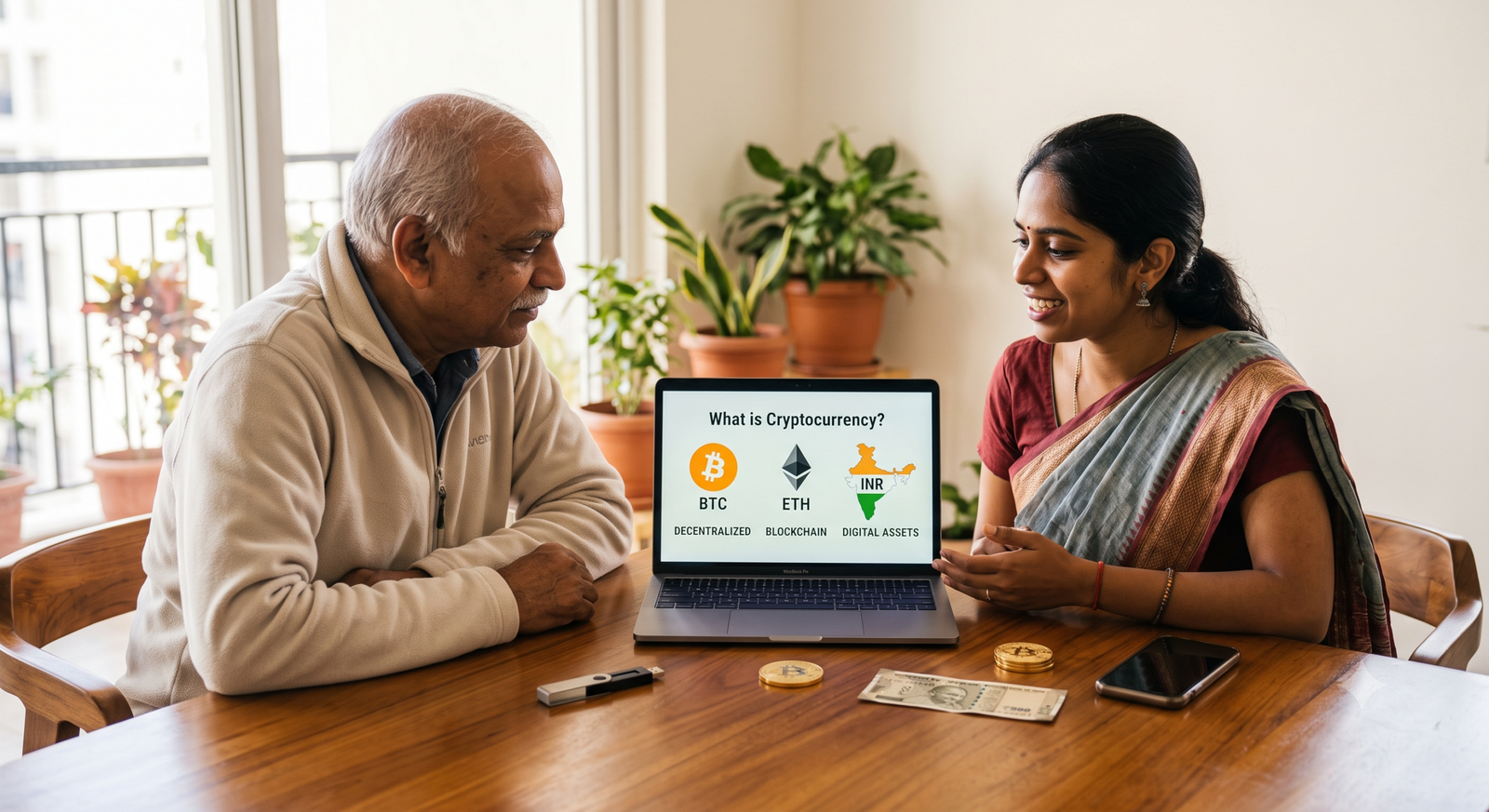
Cryptocurrency is digital money that runs on a shared public record called a blockchain instead of being issued or controlled by a bank or government. You can send it to anyone with an internet connection, store it in a digital wallet, and buy or sell it on an exchange. Bitcoin and Ethereum are the best-known examples.
If you’re in India, that simple answer comes with a few local details that matter a lot. Crypto is not banned here, but it is not legal tender either. Profits are taxed at a flat 30%, and a 1% TDS is cut on most sales. Exchanges must also register with India’s Financial Intelligence Unit.
This guide explains what cryptocurrency is, how it works, the rules Indian users need to know, and how to get started without making the mistakes most beginners make.
What is cryptocurrency, in plain words?
Think about how UPI works. When you pay ₹500 to a friend, your bank and their bank update their records. The banks, along with NPCI, are the trusted middlemen who confirm the money moved.
Cryptocurrency removes that middleman. Instead of one bank keeping the record, thousands of computers around the world each keep a copy of the same ledger. When you send crypto, those computers check the transaction and agree that it’s valid. Once they agree, it’s added to the ledger permanently.
The “crypto” part comes from cryptography, the maths used to secure transactions and prove who owns what. You don’t need to understand the maths to use it, the same way you don’t need to understand banking software to use a debit card.
How does cryptocurrency work?
Three building blocks make crypto function: the blockchain, wallets and keys, and the network that confirms transactions.
The blockchain: a shared ledger
A blockchain is a list of transactions grouped into “blocks.” Each new block is linked to the one before it, forming a chain. Because every block depends on the previous one, changing an old record would mean rewriting every block after it on most of the network’s computers at once. On a large network like Bitcoin, that is practically impossible.
This is why people call blockchains tamper-resistant. Anyone can view the record, but no single person can quietly edit it.
Wallets and keys: how you own crypto
Your crypto doesn’t sit inside an app like cash in a purse. It lives on the blockchain. What you hold is a pair of keys:
- Public key (or address): Like your UPI ID. You share it so people can send you crypto.
- Private key: Like your UPI PIN, but far more powerful. Whoever has it controls the funds. If you lose it, there is no bank to call for a reset.
A crypto wallet is simply the tool that stores these keys. Some wallets are apps on your phone, some are small hardware devices, and some are managed for you by an exchange.
Mining and validation: who confirms transactions
Someone has to check that you actually own the coins you’re sending. Different cryptocurrencies do this in different ways:
- Proof of Work (used by Bitcoin): Computers called miners compete to solve a hard puzzle. The winner adds the next block and earns new bitcoin as a reward. This uses a lot of electricity.
- Proof of Stake (used by Ethereum since 2022): Validators lock up their own coins as a deposit. They’re picked to confirm blocks and lose part of their deposit if they cheat. It uses far less energy.
Either way, the goal is the same: get thousands of strangers to agree on one honest record without trusting a central authority.
Popular types of cryptocurrency
There are thousands of cryptocurrencies, but most fall into a few groups. Knowing the group tells you a lot about what a coin is meant to do.
| Type | Example | What it’s used for |
|---|---|---|
| Original cryptocurrency | Bitcoin (BTC) | A scarce digital asset, capped at 21 million coins. Often called “digital gold.” |
| Smart contract platforms | Ethereum (ETH), Solana (SOL) | Networks that run apps, such as lending tools, games, and NFT marketplaces. |
| Stablecoins | USDT, USDC | Tokens pegged to the US dollar, used to move value without big price swings. |
| Meme coins | Dogecoin (DOGE) | Driven mostly by online communities and hype. Extremely volatile. |
Everything other than Bitcoin is often called an “altcoin.” As a beginner, it helps to start by understanding Bitcoin and Ethereum before exploring smaller coins. Smaller coins can rise fast, but many also fall to near zero and never recover.
Cryptocurrency vs the digital rupee
Indians often confuse crypto with the RBI’s digital rupee (e₹). They are very different. The digital rupee is a central bank digital currency (CBDC). It is issued and backed by the RBI, and one e₹ is always worth one rupee. Cryptocurrency is not issued by any government, and its price moves with market demand.
Is cryptocurrency legal in India?
Yes, buying, selling, and holding cryptocurrency is legal in India. It is not legal tender, though. That means no shop is required to accept it, and the government does not guarantee its value.
Here’s how the rules stand today:
- No ban. In 2020, the Supreme Court set aside an RBI circular that had stopped banks from serving crypto businesses. Since then, Indian exchanges have operated openly.
- No dedicated crypto law. India has not passed a specific law for cryptocurrency. Instead, it regulates crypto through tax and anti-money-laundering rules.
- Exchanges must register. Crypto platforms serving Indians must register with the Financial Intelligence Unit (FIU-IND) under the Prevention of Money Laundering Act. FIU-IND has acted against unregistered offshore platforms, so check that any exchange you use is registered.
How cryptocurrency is taxed in India
Indian tax law calls cryptocurrency a Virtual Digital Asset (VDA). The rules are strict, and every beginner should understand them before buying.
| Rule | What it means for you |
|---|---|
| 30% flat tax on gains | Profit from selling or swapping crypto is taxed at 30%, plus surcharge and 4% cess, whatever your income slab. |
| Only cost is deductible | You can subtract what you paid for the coin. Fees, internet bills, or other expenses cannot be deducted. |
| No loss set-off | A loss on one coin cannot reduce your gain on another coin or any other income. It also can’t be carried forward. |
| 1% TDS on sales | 1% of the sale value is deducted when you sell, above ₹50,000 a year for most individuals (₹10,000 in some cases). You can claim it back in your ITR. |
| Reporting in ITR | Crypto gains go in the VDA schedule of your income tax return. |
A quick example: you buy Bitcoin for ₹1,00,000 and later sell it for ₹1,20,000. Your ₹20,000 gain is taxed at 30%, so you owe ₹6,000 plus cess. If you lost ₹15,000 on another coin that same year, you still pay tax on the full ₹20,000.
The new Income Tax Act, 2025 came into force on 1 April 2026 and renumbered many sections, but the 30% tax and 1% TDS carried over unchanged. From FY 2026-27, exchanges also have to report user transactions to the tax department, so every trade on an Indian platform is visible to it. (source)
This is general information, not tax advice. Tax rules change, so check with a chartered accountant before filing.
How to buy cryptocurrency in India: step by step
Buying your first crypto takes less than an hour on most Indian platforms. The process looks a lot like opening a demat account.
- Pick an FIU-registered exchange. Look for an exchange that is registered with FIU-IND, supports INR deposits, and has a clear fee page. Read recent user reviews about withdrawals and customer support, not just the app’s rating.
- Complete KYC. You’ll need your PAN, Aadhaar, a selfie, and a linked bank account. Exchanges are required to verify your identity before you can trade.
- Add rupees. Deposit INR through UPI, IMPS, or bank transfer. Start with an amount you’d be comfortable losing completely.
- Place a small first order. Choose a coin and buy. You don’t need a whole bitcoin. You can buy a fraction, even ₹100 worth.
- Decide where to store it. For small amounts, leaving coins on a reputable exchange is simpler. For larger amounts, many people move them to a personal wallet they control.
- Keep records for tax. Download your trade history and TDS statements every year. You’ll need them when filing your ITR.
One tip that saves beginners money: check the total cost of a trade, not just the listed fee. The spread (the gap between buy and sell prices) and withdrawal fees can add up quickly on small trades.
Risks every Indian beginner should know
Crypto can rise sharply, but it can fall just as fast. Before you invest, be clear about what you’re taking on.
Price swings are large. It’s normal for crypto prices to move 5 to 10% in a day. Drops of 50% or more have happened several times in Bitcoin’s history. If that would keep you up at night, keep your allocation small.
There’s no safety net. Your bank deposits are insured up to ₹5 lakh by DICGC. Crypto has no such protection. If an exchange shuts down or gets hacked, you may not get your money back.
Mistakes are permanent. Send crypto to the wrong address and it’s usually gone for good. Always double-check the address and network, and send a small test amount first.
The tax bite is heavy. With 30% tax and no loss set-off, a strategy of frequent trading can leave you paying tax even in a year when you lost money overall.
Common crypto scams in India
Market crashes aren’t the only way to lose money. Scams target new investors constantly, so watch out for these:
- “Guaranteed returns” schemes. Anyone promising fixed daily or monthly profits is almost certainly running a Ponzi scheme.
- Telegram and WhatsApp trading groups. Strangers add you to groups, show fake profit screenshots, then push you to a lookalike app where your deposit can’t be withdrawn.
- Fake customer support. Scammers pose as exchange staff on social media and ask for your login or wallet recovery phrase. Real support staff will never ask for these.
- Pump-and-dump coins. Unknown coins hyped by influencers often crash right after insiders sell.
Simple safety habits
- Turn on two-factor authentication using an authenticator app, not just SMS.
- Never share your private key or recovery phrase with anyone, for any reason.
- Write your recovery phrase on paper and store it offline, not in screenshots or cloud notes.
- Only download exchange apps from official app stores, and check the developer name.
- Report fraud at cybercrime.gov.in or by calling the 1930 helpline.
Should you invest in cryptocurrency?
That depends on your goals, your timeline, and how much risk you can handle. Many financial planners suggest building an emergency fund and regular investments, such as mutual fund SIPs, first. If you then want crypto exposure, a small slice you can afford to lose is a sensible way to learn how it works.
Whatever you decide, understand the tax rules before you trade and treat any promise of easy money as a red flag.
Key takeaways
- Cryptocurrency is digital money recorded on a blockchain, with no bank or government in control.
- It’s legal to buy, sell, and hold in India, but it isn’t legal tender.
- Gains are taxed at a flat 30%, losses can’t be set off, and 1% TDS applies on sales.
- Use only FIU-registered exchanges and never share your private key or recovery phrase.
- Start small, and only invest money you can afford to lose.
Frequently asked questions
What is cryptocurrency in simple words?
A. Cryptocurrency is a type of digital money that exists only online. It’s secured by cryptography and recorded on a public ledger called a blockchain, so no bank is needed to approve transactions.
Is cryptocurrency legal in India in 2026?
A. Yes. Buying, selling, and holding crypto is legal. It is not legal tender, and exchanges must register with FIU-IND. Gains are taxed under the Income Tax Act.
How much tax do I pay on crypto profits in India?
A. You pay a flat 30% on gains, plus surcharge and cess. A 1% TDS is also deducted on sales above the yearly threshold, which you can adjust against your final tax.
Can I buy cryptocurrency with ₹100?
A. Yes. Most Indian exchanges let you buy a fraction of a coin, so you can start with a very small amount.
Is cryptocurrency safe?
A. The technology itself is secure, but prices are volatile and scams are common. Your safety depends mostly on the exchange you choose and how carefully you protect your keys.
What is the difference between Bitcoin and cryptocurrency?
A. Bitcoin is one specific cryptocurrency, the first one, launched in 2009. “Cryptocurrency” is the broader category that includes Bitcoin, Ethereum, stablecoins, and thousands of others.